AgentConductor brings AI specialists into a standard SDLC workflow you customize. Define the stages. Choose the agents. Set the review gates. No deep technical knowledge required. You focus on what gets built.
Full development capacity at a fraction of the cost. No engineering team required.
Join the waitlist. Works with any language, framework, or tech stack.
You need to build software. But hiring a full engineering team is slow, expensive, and impossible to scale. The backlog grows. The budget does not.
Stories lose momentum every time they change hands. Context evaporates. Requirements get misread. What should take hours stretches into days of back-and-forth.
Your backend architect is in three meetings. Your security reviewer has a two-week queue. One unavailable person stalls the entire pipeline.
Under deadline pressure, something always gives. Code reviews get rushed. Security audits get deferred. Test coverage drops. You ship faster today and pay for it next quarter.
Hiring takes months. Onboarding takes longer. You cannot justify a full engineering staff, but you still need production-quality software. The gap between what you need built and what you can afford to staff keeps growing.
AgentConductor uses a Kanban-style board where each column is owned by an AI agent you configure. Add as many stages as your workflow demands, or keep it lean. Set human review gates wherever you want them. Here is one example of how a pipeline can flow:
Write a user story in plain language: what you want built, who it is for, and why it matters. That is all AgentConductor needs to start.
The Story Refiner agent analyzes your story, adds detailed acceptance criteria, identifies edge cases, and estimates complexity. You review and approve before it moves forward.
Two agents work in sequence. The UI/UX Designer creates component inventories and responsive strategies. The Backend Architect designs APIs and data models. Both plans are grounded in your existing codebase.
Development agents implement the design in whatever language your project uses. Code is committed directly to your git repository, following your existing patterns and conventions.
The QA agent performs comprehensive code review: test coverage verification, architecture plan compliance, and acceptance criteria validation. Then the Security Auditor runs OWASP vulnerability detection, dependency auditing, and secrets scanning.
The completed, reviewed, and security-audited story lands in UAT for your final sign-off. What used to take a full sprint now moves through the pipeline in hours.
A familiar interface. A Kanban board where every column has an AI agent ready to pick up work. Real agent profiles with performance metrics and activity history.
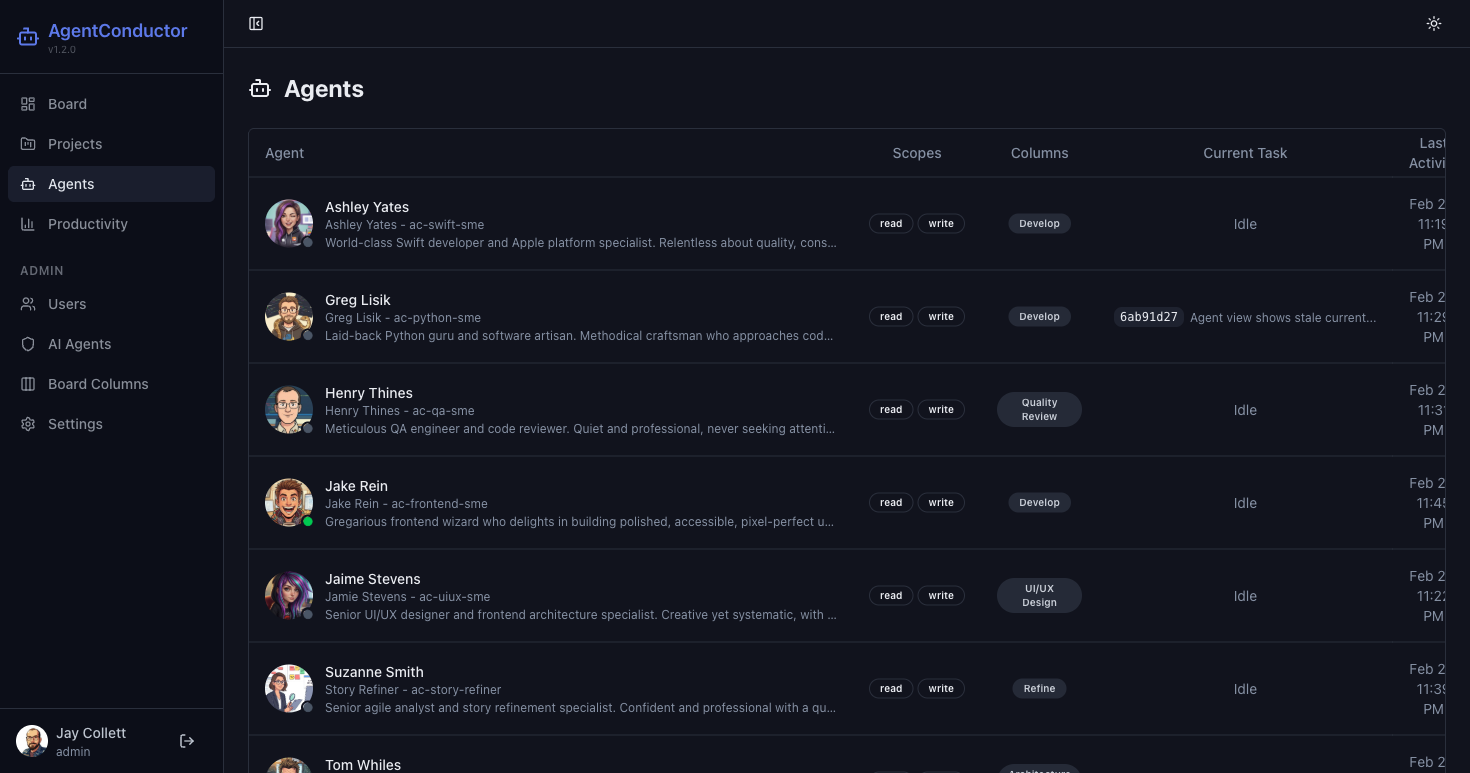
Your AI team at a glance - each agent's specialty, status, and current workload.
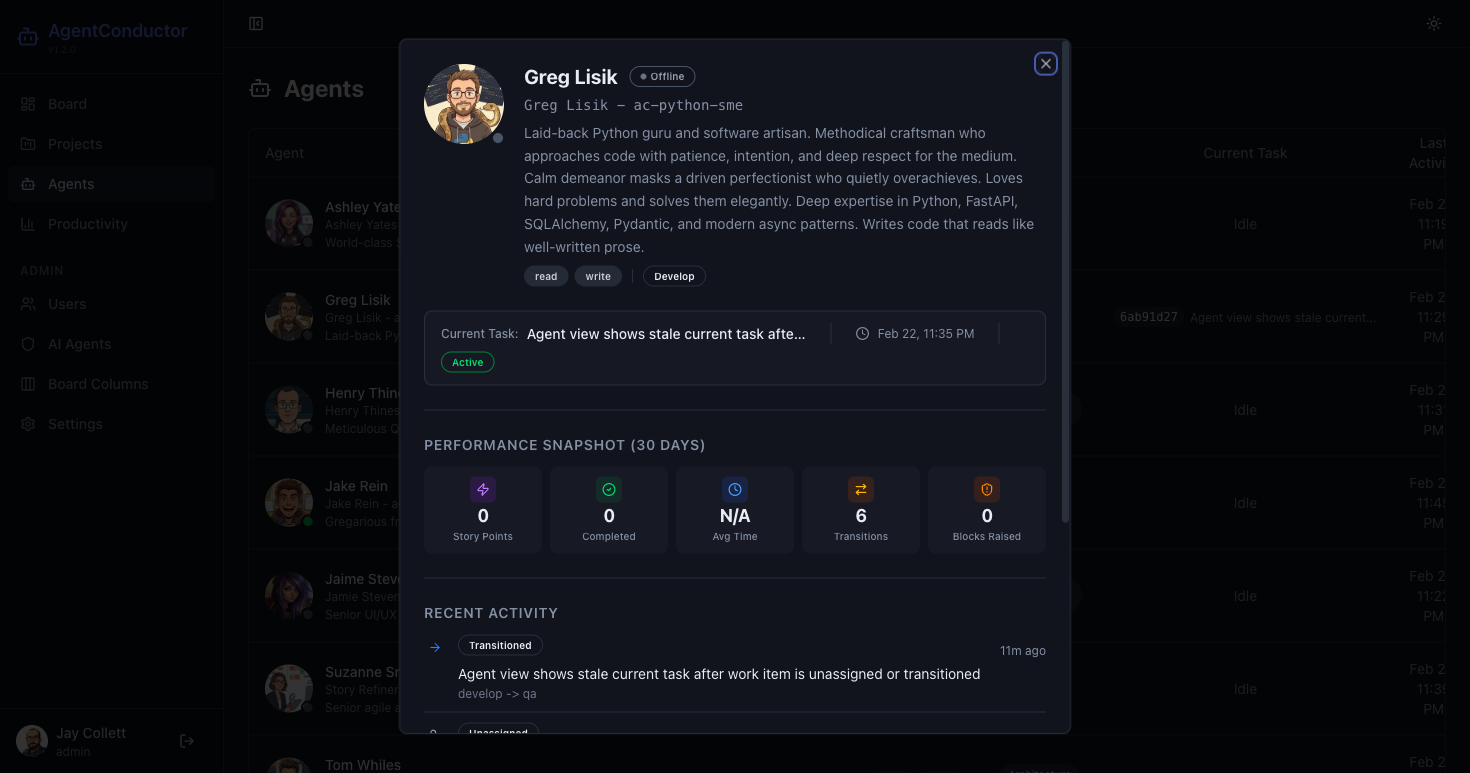
Drill into any agent - performance snapshots, current tasks, and full activity history.
Every agent is a configurable subject matter expert, tuned to your codebase and conventions. Use the ones that fit your workflow, or build your own. Here are some examples:
Transforms rough ideas into well-structured user stories with complete acceptance criteria, edge case analysis, and story point estimates. Evaluates every story against INVEST principles.
Creates design plans including component inventories, color palettes, typography systems, responsive strategies, and accessibility specifications. All informed by your existing codebase.
Designs API contracts, data models, and service architecture that integrate with your existing systems. Produces technical plans that eliminate the gap between design and implementation.
Development agents backed by the AI platform of your choice: Anthropic Claude, OpenAI Codex, Google Gemini, or others. Each writes production-grade code in any language, following your project's conventions and building on your existing architecture.
Performs rigorous code review against the architecture plan, verifies test coverage, validates acceptance criteria, and checks for regressions. Catches issues that slip through when human reviewers are rushed.
Runs OWASP Top 10 and CWE vulnerability detection, injection testing, cryptographic review, dependency auditing, and secrets scanning. Security is not an afterthought. It is a structural part of every pipeline.
Define the stages, agents, and review gates that match your SDLC. Add or remove pipeline steps as your workflow evolves. No rigid framework. Your process.
AI agents do not attend standups, take PTO, or lose context between meetings. Stories that would wait days for a review move through the pipeline in hours.
A mid-level engineering team costs $500K+ per year in salaries alone. AgentConductor delivers comparable output without hiring, onboarding, or benefits. Scale your development capacity without scaling your headcount.
AgentConductor is not locked to a single language or framework. Configure your agents for whatever stack your project requires. Capabilities scale with the AI platform behind them: Anthropic Claude, OpenAI Codex, Google Gemini, or others.
Every story passes through a dedicated security audit before reaching UAT. Vulnerability detection, dependency analysis, and secrets scanning are structural parts of the pipeline, not optional add-ons.
Add human review gates at every stage, or only where it matters most. Run fully autonomous for low-risk work. Require sign-off for critical deployments. You decide.
AgentConductor abstracts the complexity of managing AI coding agents behind a familiar Kanban interface. Write stories in plain language, review outputs visually, and ship without needing to write a single line of code yourself.
AgentConductor works directly with your private repositories. Your source code is never stored, shared, or used to train models. You retain full ownership and control.
For structured development work, yes. The agents handle story refinement, design, implementation, code review, and security auditing autonomously. You still need someone to define what gets built and oversee the pipeline, but AgentConductor is designed so that person does not need deep engineering expertise. The platform abstracts away the complexity of managing AI agents. AgentConductor replaces the team. It does not replace the decision-maker.
AgentConductor connects directly to your git repositories. Agents analyze your existing code, understand your project structure and conventions, and produce work that extends your architecture rather than starting from scratch. Code is committed to your branches, following your existing patterns.
AgentConductor is language and framework agnostic. You configure each agent for whatever stack your project uses. Agent capabilities are determined by the AI platform backing them: Anthropic Claude, OpenAI Codex, Google Gemini, or others. If the model can write it, AgentConductor can orchestrate it.
You decide where the pipeline pauses for human review. Want to approve every story before design starts? Add a gate there. Comfortable letting low-risk work flow straight through to QA? Skip the intermediate reviews. Every stage can be configured with or without a human approval step, so you get exactly the level of oversight your workflow requires.
AI coding assistants help individual developers write code faster in their editor. AgentConductor orchestrates the entire SDLC pipeline: story refinement, UI/UX design, backend architecture, implementation, code review, and security auditing. It is the difference between a faster typist and a full team that moves work from idea to production-ready code.
Every story passes through a dedicated QA review agent that checks test coverage, architecture compliance, and acceptance criteria, followed by a security audit agent that performs vulnerability scanning and dependency analysis. The pipeline does not ship unreviewed code.
We are finalizing pricing for early access. Sign up to be notified when pricing details are available. Our goal is to make AgentConductor dramatically more affordable than hiring equivalent engineering talent.
Absolutely. AgentConductor connects to your private repositories but never stores or shares your source code. Your code is not used to train any models. You retain full ownership and control over everything in your repositories.
AgentConductor gives growing businesses the development capacity they need. Reviewed, tested, and security-audited code, from user story to production, without the handoff delays, the specialist bottlenecks, or the six-figure salaries.
Request Early AccessSign up to learn more. Works with any language, framework, or tech stack.